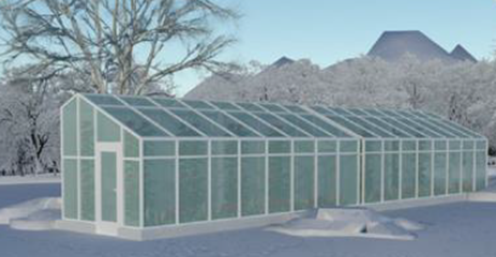
The Net Zero Greenhouse (NZG) is a modular, scalable, year‑round growing system designed to maintain stable climate conditions for producing fruits and leafy greens in cold weather conditions. Built on permaculture principles, it enables rural and remote communities to access fresh produce at lower cost while supporting local sustainability and self‑reliance. The system operates on solar and biomass energy, with a phase‑change‑material (PCM) thermal battery providing stored heat during low‑sun periods, resulting in some of the lowest operating costs in the industry.
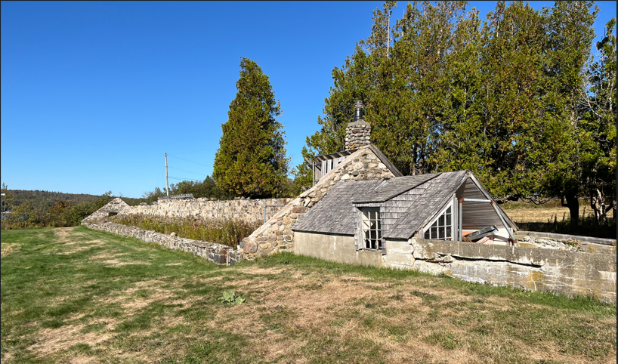
The NZG design is not new; it is derived from a proven passive‑solar greenhouse architecture that maximizes solar gain through an east–west orientation and the use of insulated north and east/west walls. To maintain year‑round operation in colder climates, the system incorporates a wood‑fired boiler to provide supplemental heating during winter months. The first Canadian example was constructed on Ministers Island in New Brunswick in 1890, where it supported the 50‑room residence of Sir William Van Horne, the industrialist and railway executive who oversaw the construction of Canada’s first transcontinental railway.
Present view of the 1890 greenhouse
The automated operation of the NZG, combined with the economic advantages of solar energy supplemented by locally sourced biomass for heating, makes it a highly viable solution for remote and off‑grid locations. The system can be configured to cultivate a diverse range of crops or dedicated to a single crop, depending on community needs and market preferences.